• mail@example.com
  • +00 123 45678
  • Mon - Sat | 7:00 - 17:00
  • mail@example.com
  • +1 2354 546 4655
Fireplace
10 Jun

Thinking About Remodeling Your Fireplace

If you’re thinking about remodeling your fireplace to your home, you’re in good company. Fireplaces create ambiance and warmth with the flip of a wall switch or tap of an app, offering convenience and beauty all at once. But remodeling fireplace is not something we do every day, so it’s normal to have questions about where to start. Whether you are adding a fireplace as part of a remodel or having one installed in a newly constructed space, consider these important questions first.

What Is Fireplace?

According to Wikipedia, a Fireplace is a structure made of stone, brick, metal, or a combination of all to contain the fire. It is an essential component in a building in cold regions of the world to create heat to warm up space.

Historically, the fireplace was used for heating a dwelling, water, and cooking the food for additional purposes. Nowadays, the fireplace offers a relaxing ambiance and remains as a place to get together, be it a home or an office.

Typical Structure of the Fireplace

According to Wikipedia, an ideal fireplace has some essential structural elements in a layout.

“A foundation, hearth, firebox, mantelpiece, chimney crane, grate, lintel, a lintel bar, home over-mantel, damper, smoke chamber, throat, flue, and chimney filter or afterburner.”

However, variations occur in design and component-based on fuel used in the fireplace and regional needs.

Different Types Of Fireplaces

Traditional Fireplaces:

Typical fireplaces found in historical places, which burnt mostly wood, coal, charcoal, and coke like traditional fuels.

Wood Burning Fireplaces:

For centuries, we are witnessing different kinds of wood-burning & coal-burning fireplaces, such as traditional open hearth, enclosed fireplaces, fireplace inserts, and combined stoves.

Modern Fireplaces:

The modern fireplaces are mainly used flammable gases and Ethanol as bio-fuels. However, we have green options, which mostly use electricity to generate heat in environment-friendly ways.

Gas Burning Fireplaces:

Against wood & coal-burning fireplaces, gas and ethanol burning fireplaces have several advantages like cost-effectiveness and less hazardous fumes. Of course, gas-burning fireplaces come in different designs, including direct-vented built-in fireplaces, ventless built-in fireplaces, and modified/converted fireplaces.

Similarly, Ethanol burning fireplaces come with some inserts to convert your existing traditional fireplaces into ethanol burning fireplaces. In addition, wall-mounted and tabletop fireplaces are available in the market, which is adapted to burn Ethanol like fuels.

Electric Fireplaces:

Electricity-based fireplaces are the most advanced types of fireplaces found in the modern age. Electric fireplaces come with several advantages, including fuel efficiency, cost-effective, and the most convenient option to create warm ambiance without environmental hazards.

If you are fond of traditional outlook, you can get electric mantel fireplaces. Otherwise, you can get a custom design like a combination of modern equipment such as TV, or Game Console like entertainment centers. Here, the sky is the limit for designing.

Fireplace Designs

Arched Surround Fireplace

An arch-type fireplace is a traditional style of fireplace that has a curved opening at the top. The arch shape is typically created with bricks or stones and can be finished with a variety of materials, such as tile, stone, or marble. This type of fireplace is often more ornamental than functional and is often used to create a decorative focal point in a room.

Artistic Stone Lay Fireplace

Of course, stone makes an excellent fireplace surround, but you can really raise the bar on your own fireplace appeal by laying the stone in a creative way. This stone seems to move across the fireplace face by wave – a fabulous elemental contrast to the fire itself. Absolutely stunning.

Reasons Why Natural Stone Is the Best Choice for Fireplace:

  • Natural Stone Can Fit into the Structure of Fireplace
  • Natural Stones Can Fit into Any Type of Fireplace
  • Natural Stones Can Tolerate Extremes of Heats of Fireplace
  • Natural Stones in Fireplace Design Are Easy to Clean & Maintain
  • Natural Stones Give Fireplace Natural Beauty


Chunky Wood Mantel Fireplace

Fireplaces themselves can’t be made of wood…for obvious reasons. But that doesn’t mean this warm natural material should be avoided altogether. In this stunning fireplace setting, for example, a chunky wood mantel and equally substantial corbels bring warmth and provide a distinct separation between the mantel face and the upper wall.


Dark Marble Tile Surround Fireplace

In a living room filled (literally) with natural light and a bright wall color, darker marble tiles on the fireplace surround are stunning. The tiles’ reflective properties enhance the window lighting, and, despite the fact that the tiles are dark, they make the room feel even brighter.

The marble fireplace surround has a more sleek contemporary style than historic marble fireplaces. This surround features honed Breccia Marrone Marble. Honed marble, rather than polished, creates a more natural texture and is more resistant to water etching than a polished finish.

If you are decorating in a contemporary or modern style, creating a fireplace with a marble surround but not covered with a fireplace mantel, make the style more sleek.


Herringbone Tile Walls Fireplace

The fireplace surround is typically more notable than the fireplace itself, but not always. Your fireplace could stand out in a crowd if you laid heat-tolerant stone tiles in a herringbone pattern. Completely and utterly stunning, even in a room with plenty of other things going very, very right.

Advantages:

  • They Create a Unique Style. Herringbone Tiles come in a variety of styles.
  • They’re Easy to Maintain. Herringbone Tiles don’t require extensive maintenance.


Low & Long Fireplace

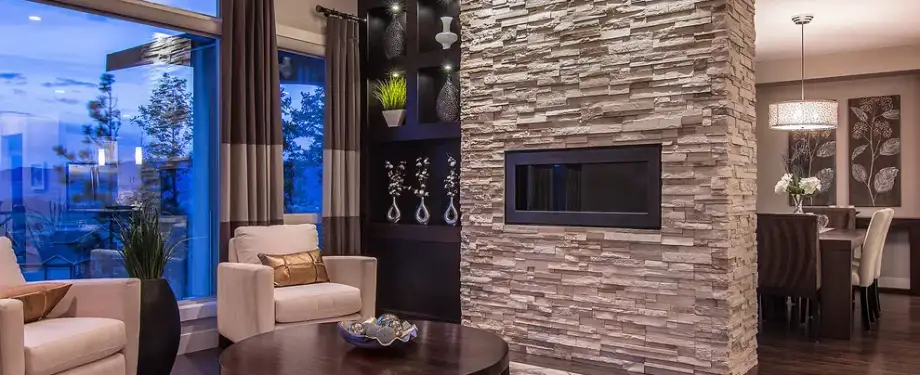
For a completely modern aesthetic, place a narrow, long fireplace below knee height. This stone example is a stunner, juxtaposing fantastically against the smooth, grey wall above. Of course, you’ll need to consider the room’s use – the presence of young children and pets might put this design on the backburner.

Traditional fireplaces have an excellent rustic aesthetic. They match well with vintage home decor styles such as modern farmhouse. Homeowners can also tailor their furniture choices so that a massive, complex fireplace gets the attention it deserves. 

However, some homeowners want more contemporary home decor styles. These often feature sleek, uniform colors and surfaces. Most traditional fireplaces clash with these. 

The rectangular, geometric shapes of linear fireplace designs match contemporary home decor styles perfectly.


Open Fireplace

Open fireplaces are open-flame fireboxes with no glass panel. They are still featured in many homes, both traditional and new ones. An open fireplace should be considered a furnishing object, used very often in order to enjoy the decorative function of the flame or to occasionally cook food over the embers.


Peep- through Fireplace

A double sided fireplace wood burning, also known as a see-through fireplace is a seamless way to experience the comfort and ambiance of wood crackling and roaring flames from two separate spaces.

Lighten up the room with a fireplace that benefits two rooms; having such a fireplace “floating” in the center of the room with plenty of room to walk around it makes the space feel even brighter and more spacious.

Simple Marble Surround Fireplace

The simplicity of a contemporary marble surround, with smooth surfaces and clean angles and lines, will make the fireplace the first thing everyone will notice when they come into your living room. We like the contrast of white surround with a colored wall.

Advantages:

  • Classic, Luxury Feel.
  • Durability.
  • Fire Resistance.
  • Neutral Décor.
  • Marble is a metamorphic rock made up of recrystallized carbonate minerals, primarily calcite and dolomite. 


Solid Simple Concrete Fireplace

Raw concrete is all the rage in the industrial style, and its use as a fireplace surround and mantel face is en pointe here. Although the contrast between the harsh concrete and the tree branches overhead is impactful, if you’re unable to incorporate the natural look in this way, the concrete fireplace itself would be an eye-catcher in any space.

Advantages:

  • Extremely Durable Material
  • Fireproof
  • Lasts a Long Time
  • Low-Maintenance

Stone Fireplace Wall

We’ve all seen fireplaces in which the mantel face is stone from floor to ceiling; however, consider this stunning impact when the stone is laid floor to ceiling, end to end on the entire wall. The fireplace wall is immediately and entirely the focus of this space, and no other art or décor is even needed.

Advantages:

  • Design consistency
  • Durability
  • Increasing home value

Tall Fireplace Box

So often, a fireplace box is an expected size. But if your mantel face is tall and slim, it might make excellent sense to have the fireplace box itself mimic this silhouette by being taller than the standard form. This design is remarkable in its simplicity and aesthetic appeal.


Tile frame Fireplace

A simple  fireplace insert can really stand out with the right frame. Use wide heat-tolerant tiles to frame out the insert in a simple, clean-lined way. This is a great way to soften the transition from the harsh black edges of an insert to the rest of your space.

Tile is one of those workhorse materials great for fireplace. That’s because of the way that it is produced. It is made from very fine white clay baked in a kiln around 2,300 to 2,400 degrees Fahrenheit. These extreme temperatures are what make it so dense, That’s why tile is often used in outdoor applications, appearing in everything from outdoor kitchens to patios. The tile can withstand cold winters, pouring rains, and baking hot summers. That’s also why it’s such a great pick for fireplace hearths.

It has a high heat tolerance, making it a much better pick over other options like marble or ceramic. It’s so heat-tolerant that you can even install the tile inside the fireplace, and it won’t crack or smoke. However, this is not advised since nothing is 100% foolproof, and depending on how much you use your fireplace, you may eventually see damage to the interior porcelain tile.


Vertical Tile Fireplace

Push the envelope a bit with how you choose to lay the tile on your fireplace wall. Long, slim tiles laid vertically, like a waterfall, draw the eye upward and work beautifully with the concept of the fire’s flames. We love the juxtaposition of water and fire in this concept.

also, The benefits you actually get with this look is a small fireplace can seem much more taller with a vertical tile. Vertical lines naturally create the illusion of a higher ceiling and the presence of more space. This is also a very affordable way of giving your fireplace a unique look. All you are doing here is changing the orientation of the tile and that costs you almost nothing extra. Beautiful and chic, this instantly alters your fireplace vibes.


Conclusion:

Fireplace undoubtedly a vital place in the home and outdoor design. The living room or seating room in the indoor designs are often the best spaces for fireplace installation whereas, bedroom seldom becomes a choice.

In outdoor applications, fireplace occurrence remains higher in colder regions of the world. Paving Patios and outdoor kitchens are witnessing classic to modern fireplace designs using various natural stones.

Of course, natural stones are available here & there, but the desired quality and stone types are rare things in the market. Murad Floors is a dependable place to get a vast inventory of various kinds of natural stones in your vicinity from its vast distribution network. You can get the best deal online as well as in-person visits.

Leave A Comments

All Copyrights Reserved By Draaz

Exit mobile version